Warehouse Safety Barriers: Why Joule Ratings Are the Only Fair Way to Compare Strength
If you’re weighing up safety barriers for your site, the fairest way to make a confident warehouse safety decision is by comparing joule ratings.
A barrier’s joule rating tells you how much impact energy it can absorb without failing – your most objective measure of true impact protection.
What a Joule Rating Actually Means
A joule is a unit of energy. In barrier testing, it represents the energy a barrier can safely absorb in a collision. The physics behind it is simple:
Impact energy (J) = ½ × mass (kg) × speed (m/s)²
Know the vehicle’s weight and a realistic speed, and you can estimate the energy of a crash. That’s why joules cut through the noise of height, colour, or post diameter. Those features might affect looks or visibility, but only energy absorption tells you what a barrier can truly take.
Example:
A 4-tonne forklift travelling at 5 mph (≈2.24 m/s) carries about 10,035 joules of crash energy:
½ × 4,000 × (2.24)² ≈ 10,035 J.
That’s more than enough to crack concrete, deform steel, or burst through a light pedestrian fence. It’s also why choosing by joules matters.
Why Test at 45° (and Why That Helps You Compare)
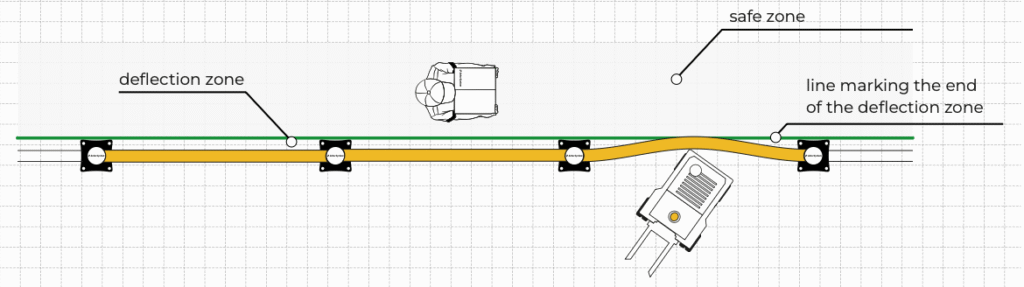
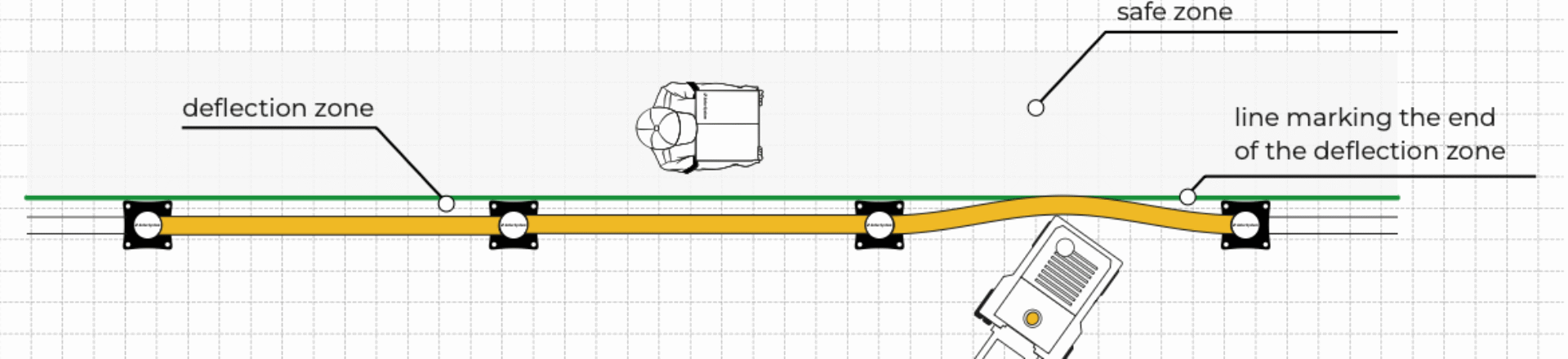
Most real Forklift bumps are angled, not head-on: a driver turns too tight, reverses near a walkway, or a load clips the edge of a barrier. Responsible testing uses a 45° impact because it better reflects how forklifts actually hit things — so the rating you see matches real-world conditions, not just lab results.
When comparing products, always check what angle the rating refers to. A 45° test gives you the clearest picture of how the system will behave on your floor.
For calculations: A 45° impact typically transfers about half the energy of a 90° (head-on) impact. So, use your standard joule calculation to find the head-on impact energy, then halve that figure to estimate the 45° impact energy.
The Anter System HD+ Ratings (Tested at 45°)
To make like-for-like comparisons easier, here are the tested Anter System HD+ impact ratings at 45°:
- Pedestrian R2 HD+ — 9,800 J (e.g., 4-tonne FLT at 6 mph @45° ≈ 7,194 J)
- Pedestrian R3 HD+ — 11,800 J (e.g., 6-tonne FLT at 6 mph @45° ≈ 10,800 J)
- Traffic R2 HD+ — 25,800 J (e.g., 5.5-tonne FLT at 9 mph @45° ≈ 22,258 J)
- Traffic R3 HD+ — 40,600 J (e.g., 8-tonne FLT at 9 mph @45° ≈ 32,375 J)
- GB Double Floor Ø200 HD+ — 46,500 J (e.g., 9-tonne FLT at 10 mph @45° ≈ 44,965 J)
These numbers are the real difference between “similar-looking” barriers. If you’re comparing options from different brands, line up the joule ratings for the same test angle — that’s the fairest way to judge actual strength.
How to Use Joules to Make a Confident Choice

- Identify your heaviest vehicle and realistic top speed for the zone.
- Use the simple formula (½ m v²) to estimate crash energy.
- Pick a barrier with a joule rating above that number for a safe margin.
That’s it – no guesswork, just physics.
The takeaway for warehouse and forklift safety
- Joules are the common yardstick. They tell you what a barrier can actually absorb.
- 45° testing reflects reality. It mirrors how forklifts tend to collide in live operations.
- Compare like-for-like. Same test angle, then higher joules = stronger safety barrier.
Need More Help Choosing a Safety Barrier for Your Facility?
If you’d like, share your heaviest vehicle and typical speeds by area. We’ll map the numbers against the Anter System ratings so you can publish a clear, defensible choice on your site – one that protects people, infrastructure, and floors without over- or under-specifying.
Back to blog“Joules are the common yardstick. They tell you what a barrier can actually absorb.”
Ready to start investing in your safety? Our team of experts is available to help you plan, structure and build your project.
Contact UsWarehouse Safety Barriers: Why Joule Ratings Are the Only Fair Way to Compare Strength


